


Guide
NFC or a QR code: which should go on a card?
A tap wins when the thing is handed to a person. A code wins when it is read from further than an inch away, or shown on a screen. That is genuinely the whole answer — and it is why a counter sign should carry both and a keepsake usually should not.
What each one actually asks of the person
Both do the same job: they get a web address out of a printed object and into a phone. They ask for completely different things to do it, and that is where the decision lives.
A tap asks for contact
The phone has to come within about an inch of the chip. In exchange it asks for nothing else at all — no camera, no app, no light, no aim, and no second hand. Somebody holding a drink can do it. Somebody in a dark room can do it. Somebody who has never heard of NFC can do it, because the phone does the explaining.
The cost is that the phone has to be new enough, and on Android the feature has to be switched on. Both are usually true and neither is always true; the honest breakdown of which phones read a tap lives on how it works, where it is kept up to date.
A code asks for attention
A QR code needs a camera pointed at it, held steady, with enough light to resolve the pattern. That is three small demands rather than one, and each of them fails in ordinary conditions: a dim restaurant, a moving car, a phone in the wrong hand, a printed square that has creased.
What it buys is range and reach. A code works from a distance, works on a screen, works on paper, works on a wall, and works on a phone from 2014. Nothing about it depends on hardware inside the object, because there is no hardware inside the object.
Where a tap is the right answer
- Anything passed hand to hand. A business card, a favor, a keepsake. The object is already an inch from someone; asking them to photograph it instead is asking for more.
- Anything with a picture on it. A code has to be printed, at a usable size, somewhere on the face. On a card that is mostly somebody’s photograph there is nowhere for it to go that does not spoil the reason the card exists.
- Anything you want to look like an object rather than a link. A printed code announces that the thing is a redirection. A card with a chip in it just looks like a card, which matters more than it sounds for something meant to be kept.
Where a code is the right answer
- Anything read at a distance. A poster, a table tent, a shop window, a slide. NFC has no version of this. An inch is an inch.
- Anything on a screen. A code survives being screenshotted, emailed, put in a slide deck or shown on a till display. A chip cannot be sent to anybody.
- Anything that has to work for absolutely everyone. If your audience skews older, or you have one shot at a stranger and no way to follow up, the code is the one that leaves nobody out.
- Anything you are printing thousands of on paper. A code costs ink. A chip costs a chip.
The case for both, and the case against
Putting both on one object removes the single biggest failure mode of each — the phone that cannot tap, and the customer who will not aim a camera. Where there is room, both is simply better, and anyone telling you a tap makes a code obsolete is selling taps.
The reason not to is space, and it is not a small reason. A QR code needs to be around three quarters of an inch square to scan reliably at arm’s length, and it has to sit on a light background with clear margin around it. On a counter sign that is free real estate. On a credit-card-sized keepsake carrying a face and a date, it is a quarter of the front.
So the rule that falls out of it is about the reader rather than the technology: if the person is a stranger in a hurry, print the code. If the person is going to keep the object, do not.
What we make, and which way round
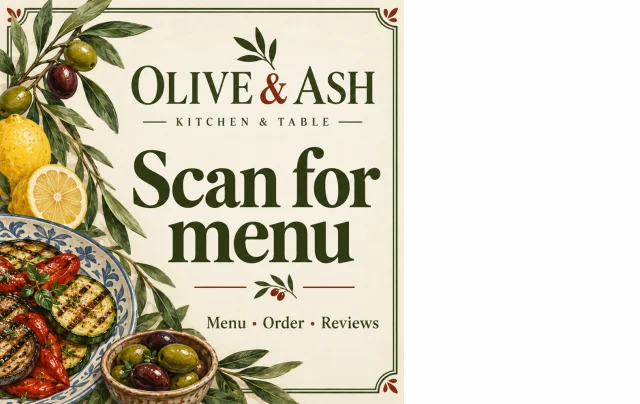
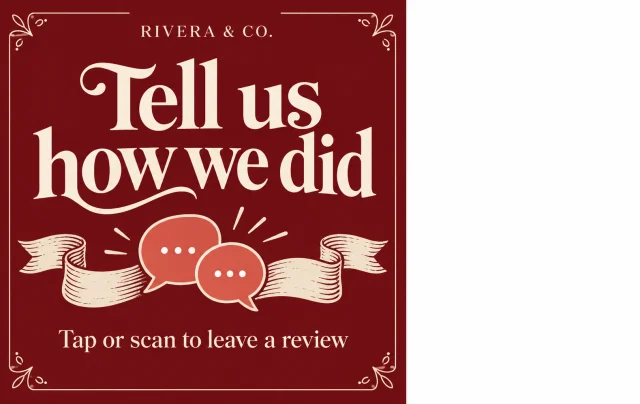
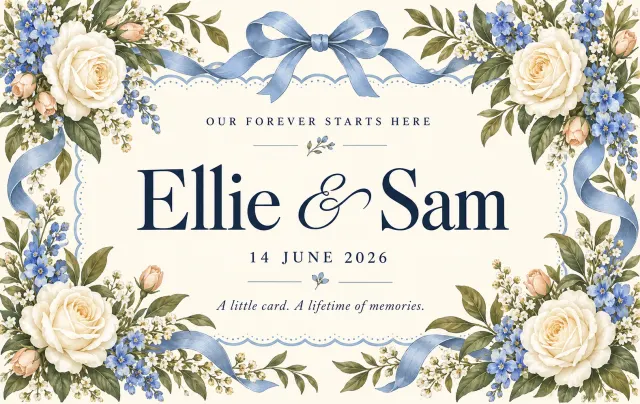
Treat this as interested rather than neutral. Our keepsake cards carry a tap and no printed code, for exactly the reason above — they are mostly photograph, and they are meant to be kept. Our review cards and counter panels carry a tap and a QR code side by side, because a customer on their way out of a shop is the other kind of reader entirely, and losing one in ten of them to an older phone is not a trade worth making for tidiness.
Both point at an address we host rather than one printed on the object, which is the part that is genuinely the same either way: whichever mechanism opens it, you can change where it goes afterwards without remaking anything.
Easier to try than to read about.
The designer is free and needs no account. Nothing is ordered until you say so.
See the cards — from $30Ships in 24 hours · Free tracked shipping · Change the video any time